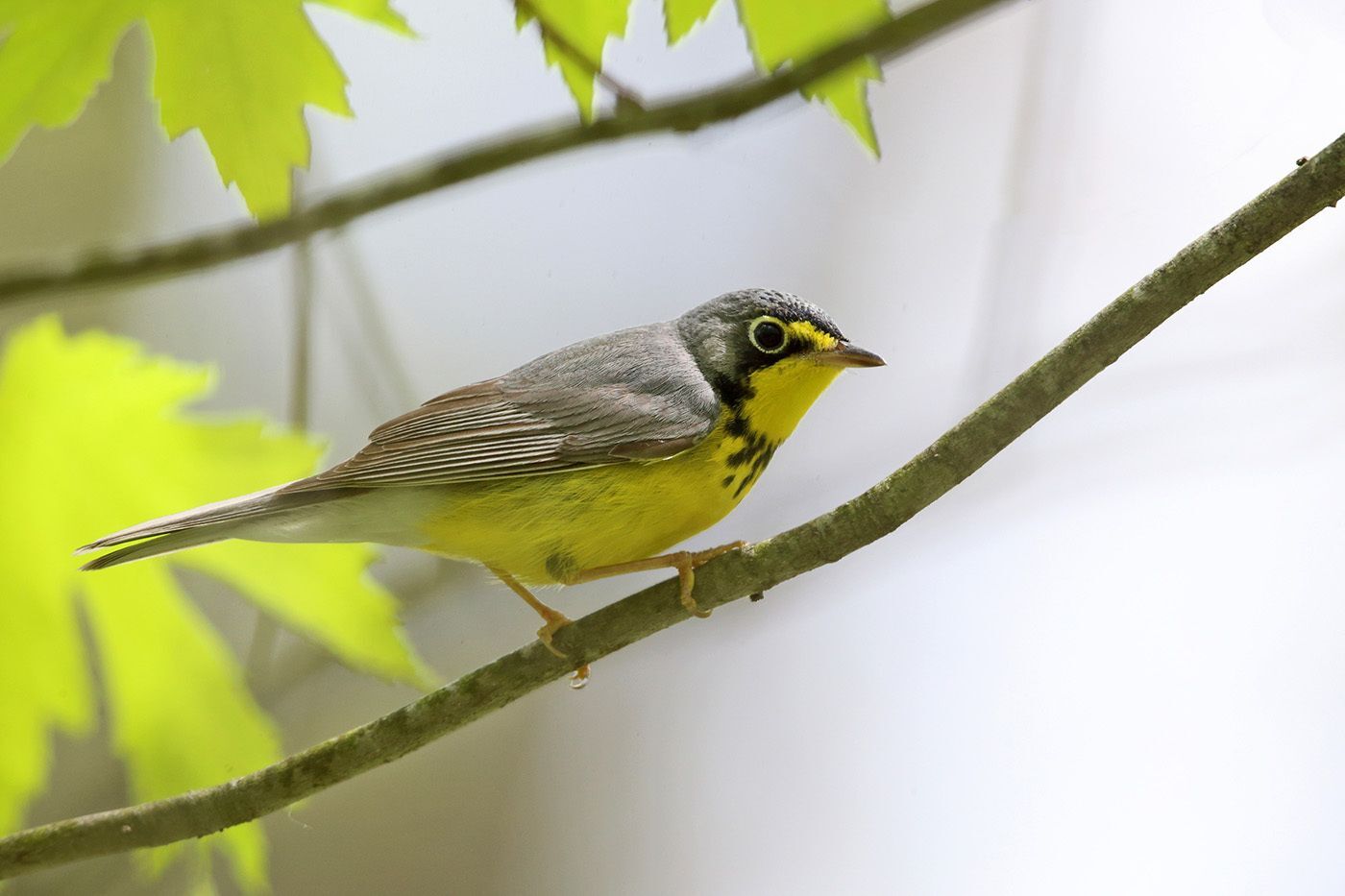
Image: Canada Warbler by Tom Murray
“Birds don’t recognize borders so we must work with our neighbors to protect them wherever they fly,” says Marshall Johnson, the chief conservation officer of the National Audubon Society. I couldn’t think of a better quote to set the tone for how the Audubon Society of Omaha approaches spring migration. Think of the incredible journey of the Blackpoll Warbler, a tiny bird that winters deep in the Amazon rainforest. Leaving Brazil, this bird flies over Venezuela, over the Caribbean Sea, Cuba, and the Gulf of Mexico before finally reaching the southern U.S. With only short stops to refuel, the bird continues north through the Midwest — maybe spending a day or two in Omaha! — then on to the breeding grounds in northern Canada and Alaska. We know this thanks to fascinating research that tracks individual Blackpoll Warblers’ migratory routes. If you’re lucky enough to catch a glimpse of this bird or hear its metallic little song this spring, know that it ties together landscapes and communities over thousands of miles.
Birds rely on each and every human community they encounter along the way to provide them with suitable habitat. It’s up to us and our neighbors in Omaha to care for this species and every other that passes through our city or spends the summer here for the breeding season. The continued survival of each species depends on everything going right at every stage of the migratory journey and every part of the breeding season. Every year, this miracle happens again — but it’s up to us to ensure that future generations get to witness it.
In this issue, we describe two ways to help migratory birds: reducing light pollution and making windows safer for birds. Let’s also recognize a third action just as important as anything we do as individuals: connecting with our neighbors and sharing what we know about wildlife conservation. Birds need more than a checkerboard of individual homeowners here and there protecting them. They need a seamless garment: a community united by its value for providing wildlife, both resident and migratory, with good habitat.
When we work together to care for wildlife, we also care for human communities. If we’re united in caring for our shared environment, our relationships with our neighbors will improve, too. In talking with our neighbors, we might find they have undertaken incredible journeys in their lives, and we might end up sharing our own journeys with them, too. Like every city in the U.S., Omaha brings together peoples and cultures from all over the world. Both birds and people know what it means to travel great distances for survival. If ASO can do its part to make Omaha a better place for everyone to live — for wildlife and for people, no matter where they’re from — we’ll help create a better place for future generations to live.