
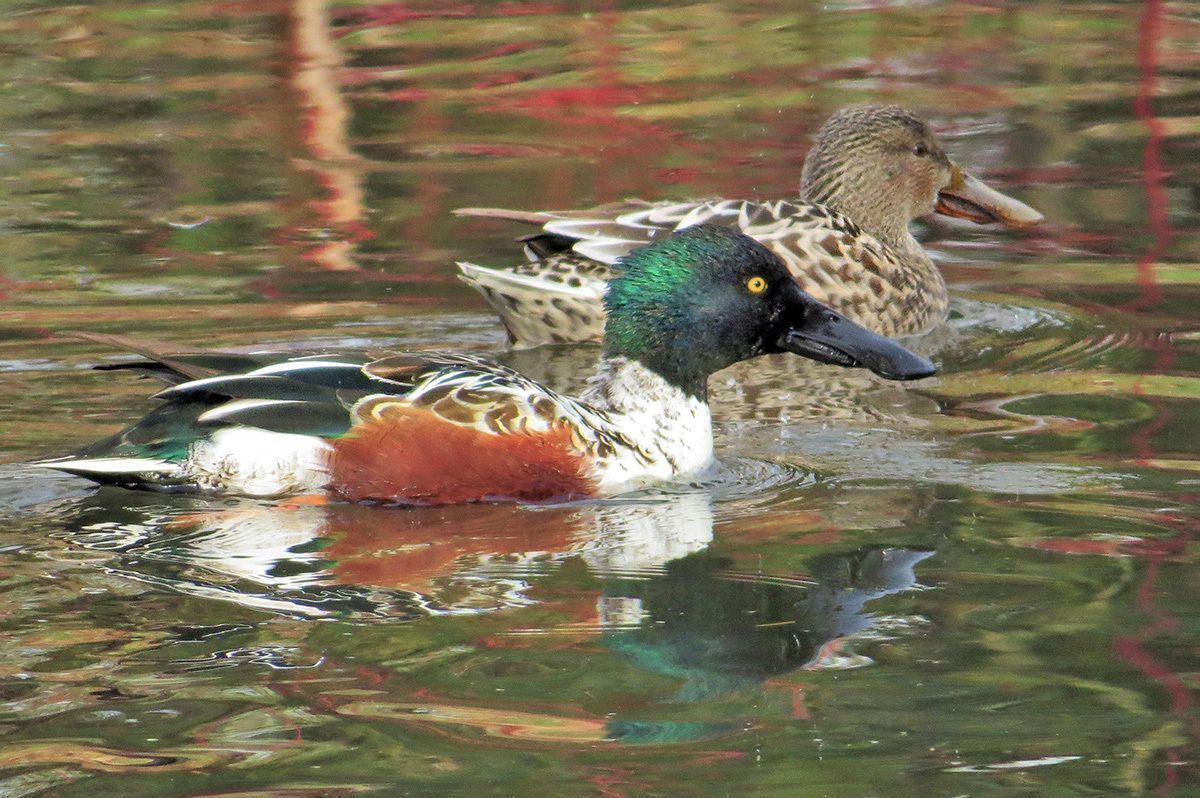
Photo: Northern Shoveler pair (male on the left, female on the right) by Richard Griffin
Many people report having a “spark bird,” the species that jumpstarted their passion for birding or that illuminated the wider world of birds. A former professor told me about the first time he looked through a spotting scope at a group of ducks on a lake and realized that there was not just one kind of duck, but many. For him, the whole group of waterfowl was his spark.
March and April are the perfect time to see ducks and other waterborne birds migrating through our metro area. If your appreciation for ducks is only surface-level right now, with room to deepen, consider the Northern Shoveler. Though it might sound like an unlikely spark bird, it just might cue you in on the wonders of the duck world. Male Northern Shovelers remix the classic green, brown, and white colors of the ever-present Mallard and add something unique: a gigantic bill, a spade for scooping big mouthfuls of water and straining out tiny arthropods. For the bill isn’t just a shovel — it has over 100 tiny projections along its sides that help pick out miniscule animals from the water, somewhat like the baleen plates in a whale’s mouth. It’s an incredible solution to the challenges of survival.
In early spring, waterbodies around Omaha swell with large numbers of Northern Shovelers and other species of migratory ducks. Looking quickly from a traveling car, students on a field trip at first told me that shovelers in Lake Manawa were Mallards. But once you get a really good look at that bird’s shovel, as those students did after we parked, you’ll never mistake them again — and you might start to realize the surprises that the duck’s branch of the tree of life has in store.
During early spring, duck species stopping by on their journey north include Blue-winged and Green-winged Teal, Canvasback, Ruddy Duck, Redhead, Lesser Scaup (more common) and Greater Scaups (less common), Bufflehead, Common Goldeneye, and more. Non-duck waterfowl such as Pied-billed Grebes, Horned Grebes, and Common Loons are also on the move. Try to find a big group of ducks, called a raft, on a lake. These are migratory species congregating at a stopover habitat. Scan the group carefully to spot differences: the perky tails of Ruddy Ducks, the sharp white crescents on the heads of Blue-winged Teals. Then see what species are diving and dabbling on the fringes of the big group: Buffleheads popping up from a swim like a cork, Pied-billed Grebes pushing their short, squat little bodies surprisingly fast through the water before vanishing below in search of prey. Each species finds its own niche in the aquatic habitat.
As you get to know birds better, you’ll find that you shift from searching for a long list of clues to identify a single species to recognizing familiar birds at a glance, much like you’d recognize a friend. Migratory species are especially valued friends to see, because we only get a chance to observe them once or twice a year.